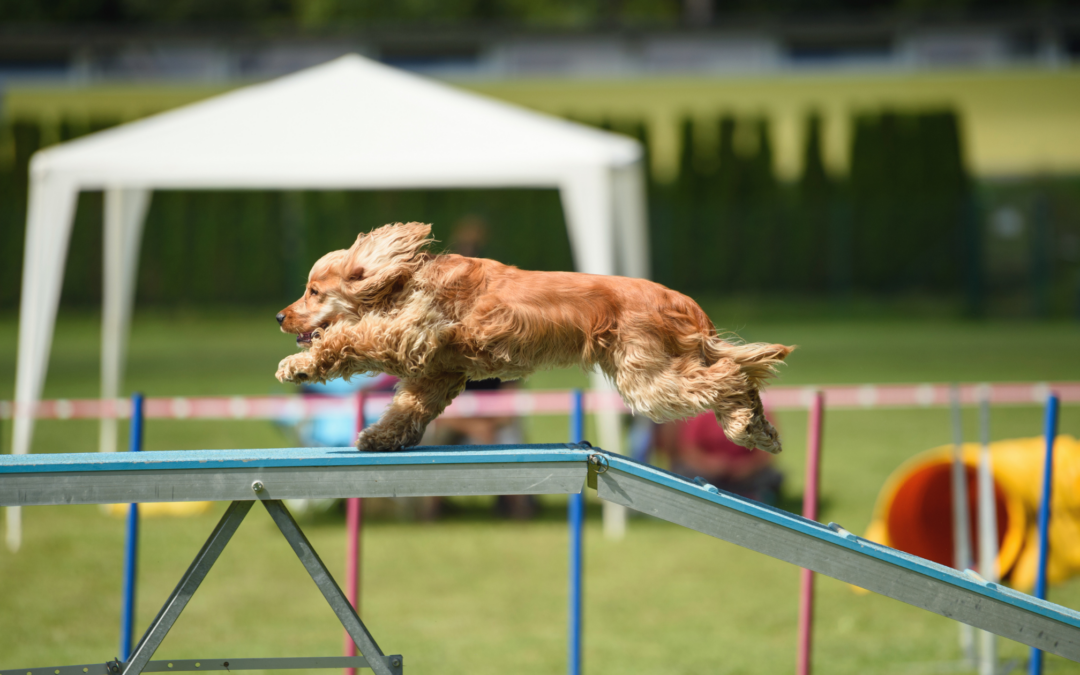
What does it take for a competitive agility dog to come back from an injury sustained in an ordinary training run? For Lauren, a six year old English Cocker Spaniel imported from the UK and, in her owner’s words, “a super fun dog to run,” that question became real last spring. She got bound up in a tunnel during a training run and came out of it not quite right. A musculoskeletal ultrasound confirmed bilateral iliopsoas insertional tears, the kind of injury that ends a competitive season and takes a long time to rehab.
What Is AlphaFlo®, and Where Does It Come From?
AlphaFlo® is a liquid, acellular canine amniotic tissue allograft made specifically for dogs. It is derived from the amniotic membrane, the tissue layer that surrounds a developing fetus. AlphaLogix sources it from healthy dogs during live birth, using licensed veterinarians and sterile recovery techniques so the process doesn’t harm the mother or puppies. Because it’s acellular, what it carries is the tissue’s matrix and signaling proteins, not live donor cells. It’s processed under current Good Tissue Practices modeled on human tissue standards, and it’s a prescription product, administered only by a licensed veterinarian. Reported properties of amniotic tissue, including anti inflammatory and regenerative effects, are attributed to amniotic tissue generally1 and are not guaranteed to any individual case. As with any allograft, use may not improve a dog’s condition, with a possibility of an adverse reaction.
Lauren’s owner, Jennifer Miller, DVM, owner of Prairie River Holistic Veterinary Services in Byron, GA, has spent twenty years in practice, the first eight in strictly equine medicine before she added chiropractic and acupuncture training and built a practice that now spans sport horses, roughly thirty sport dogs, and a handful of geriatric small animal patients. She knows agility from the inside too, and she points out that the tight, wrapping turns agility dogs make around a jump wing put a kind of strain on a dog’s body that horses, built differently, simply don’t experience the same way. Canine sports medicine is still a young specialty, with very few board certified specialists nationwide, so when it came to Lauren’s case, Dr. Miller did what she’d tell any owner to do: she brought in a specialist rather than manage it herself, referring Lauren to Brett Benson, DVM, a sports medicine veterinarian practicing out of the South Carolina area.
Why AlphaFlo® Came Up
Dr. Miller’s path to AlphaFlo® ran through the horse world first. Many of her equine patients had already used RenoVō®, a similar product for horses, and she’d seen firsthand how it performed in her own sport horses. When Lauren was injured, that experience is what led her to reach out to Ginger Johnson at AlphaLogix directly about AlphaFlo® for Lauren’s case. After looking into it, she decided it was the product she wanted to use.
How Lauren’s Recovery Went
Lauren’s healing followed what Dr. Miller described as a pretty good path, with one real setback along the way: a slight reinjury in July, which was followed by a few more doses of AlphaFlo®. She’s been back in training since August, and by the time of this interview she was doing well and about two weeks out from her first competition trial back, with an eye toward the European Open AKC team tryouts in December. Dr. Miller was pleased with Lauren’s follow up ultrasounds, and by her account, Dr. Benson, who was using AlphaFlo® on a case for the first time, was encouraged by the healing rate as well.
On why she leaned toward AlphaFlo® over repeated PRP administrations for Lauren’s case, Dr. Miller put it this way: “I always wonder if a dog gets injured, if a horse gets injured, how good is their PRP, and certainly there are plenty of studies on PRP, and I’m not downgrading PRP, but I did like the ability to know what exactly I was putting in the dog.” She was careful to frame her own experience for what it is: “With my n of one, I’m pretty excited about it.”
Asked what stood out most, Dr. Miller’s answer was simple: “I was impressed with how my dog responded to AlphaFlo®.”
A Note on This Story
These details reflect Dr. Miller’s own personal observations from her dog’s individual case, not a controlled study or a guaranteed outcome for any other dog. AlphaFlo® is a ready to use, acellular canine amniotic tissue allograft used to supplement and protect canine tissues, and clinical decisions regarding its use are made at the discretion of the attending veterinarian. Hear from other veterinarians across the country who have incorporated AlphaFlo® into their care plans at alphaflocanine.com/testimonials, or read published case studies from other athletic and working dogs.
Reference
1. Avilla-Royo, E., et al. (2021). Amniotic membrane derived products in regenerative medicine: reported properties and applications.